“Sometimes the smallest rituals have the greatest power to transform the way we experience life.”
The Ancient Yogic wisdom of the fourth finger…Take a moment to look at your hands.
Perhaps you’re wearing a wedding ring, an engagement ring, or maybe a favourite piece of jewellery that carries a special memory. We often choose rings because they’re beautiful or meaningful, but what if there was another reason our ancestors placed a ring on one particular finger?
Across cultures and throughout history, the fourth finger has become known simply as the ring finger. While many people associate this with romance and commitment, yogic tradition offers an altogether deeper explanation.
According to the teachings of renowned yogi Sadhguru, the fourth finger isn’t just another digit—it is believed to hold a unique connection to the body’s energetic system. In yogic science, placing a metal ring on this finger is said to help stabilise your energy, support your wellbeing and create a stronger foundation for spiritual growth.
Whether you embrace these teachings as spiritual truth or simply find them fascinating, they invite us to see something as ordinary as a ring in an entirely new light.
Ancient Wisdom for Modern Living
Yogic science has explored the relationship between the human body and subtle energy for thousands of years.
Rather than viewing the body as merely flesh and bone, yogis describe us as intricate energetic beings, constantly interacting with the world around us. Every breath, every thought and every action influences what is known as prana—our vital life force.
Within this tradition, each finger serves a unique energetic purpose, and the fourth finger occupies a particularly significant place.
Sadhguru describes it as something of a master key to the human system.
He teaches that wearing a metal ring on this finger helps create stability throughout the body’s energetic framework, acting almost like an anchor that keeps your internal energies from becoming scattered.
Imagine carrying a bucket filled with water that has tiny holes in the bottom. You may never notice the leaks until you arrive at your destination and discover half the water has disappeared.
Yogic teachings suggest our energy can behave in much the same way.
When our energy is stable, we often feel more balanced, resilient and present. When it is constantly dissipating, everyday life can feel surprisingly exhausting.
“The smallest practices often create the greatest shifts—not because they are magical, but because they remind us to live consciously.”
Why the Fourth Finger?
It is interesting that so many cultures independently settled on the same finger for wearing rings.
In yogic understanding, this wasn’t simply a social convention.
The ring finger is believed to have a direct relationship with the body’s foundational energy pathways. Placing a conductive metal against the skin on this finger is thought to encourage greater energetic coherence and physical stability.
Sadhguru often explains this with a wonderfully practical comparison.
Driving a car with damaged bodywork won’t stop it from reaching its destination—but it becomes less efficient, consumes more fuel and experiences greater wear and tear over time.
Similarly, he suggests that when our energies are functioning harmoniously, life requires less effort.
Does the Metal Matter?
According to yogic tradition, very much so.
Metals are not viewed merely as decorative materials. They are considered conductors that interact with our own natural bio-electrical and energetic systems.
Each possesses its own unique qualities.
Copper – The Great Grounder
Copper is perhaps the most highly regarded metal within yogic practice.
It has been used throughout history in spiritual traditions around the world because of its remarkable conductive properties.
In yoga, copper is believed to stabilise the body’s energetic field, helping practitioners remain grounded while supporting meditation and inner balance.
Traditional Ayurvedic teachings also associate copper with balancing the body’s three constitutional energies—Vata, Pitta and Kapha.
For many spiritual seekers, copper represents simplicity, humility and connection with the Earth.
Gold – The Energy of the Sun
Gold has long symbolised purity, wisdom and higher consciousness.
Yogic philosophy associates gold with the solar principle—warmth, vitality and expanded awareness.
Rather than grounding energy, gold is believed to elevate it, encouraging confidence, clarity and spiritual aspiration.
Silver – The Gentle Moon
Silver offers an altogether different quality.
Connected with lunar energy, intuition and emotional balance, silver is thought to cool the system, calm the mind and support gentle awareness.
Many people naturally gravitate towards silver during periods when life feels stressful or emotionally demanding.
The Mystery of the Copper Snake Ring
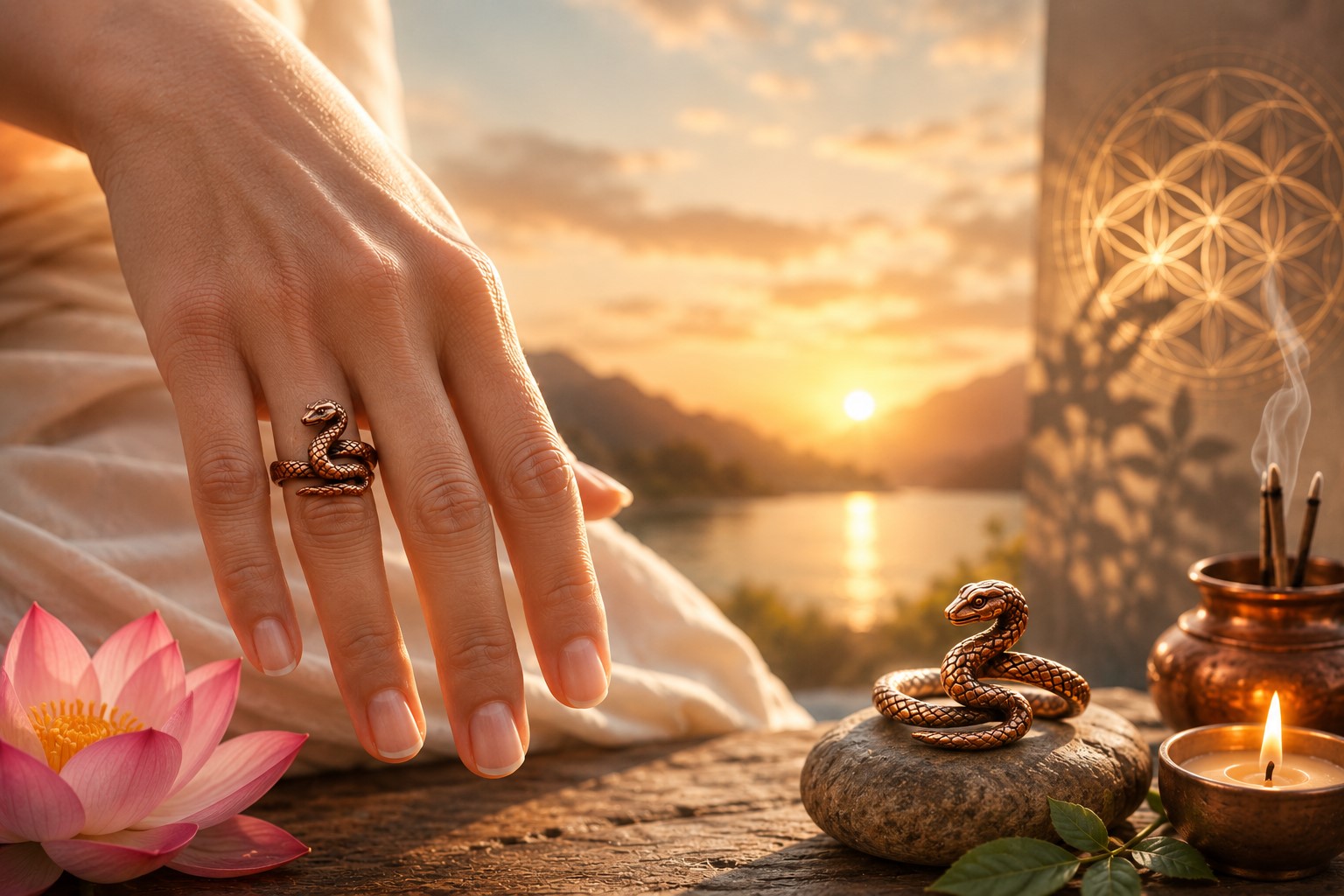
If you’ve ever watched Sadhguru speaking or attended an Isha programme, you may have noticed many practitioners wearing an unusual copper ring shaped like a coiled cobra.
Known as the Sarpa Sutra, this ring carries deep symbolic significance.
In yogic culture, the serpent represents transformation.
Just as a snake sheds its skin, we too have the ability to release limiting beliefs, old identities and emotional baggage that no longer serve us.
The serpent is also closely connected with Kundalini—the dormant spiritual energy said to exist within every human being.
Rather than being worn purely for symbolism, the Sarpa Sutra is traditionally regarded as a yantra—a spiritual tool designed to support meditation and maintain energetic stability.
Many practitioners wear it daily as part of their spiritual discipline.
Did You Know?
In yogic tradition, the Sarpa Sutra is usually worn on the left ring finger, where it is believed to provide the greatest stabilising influence. Some practitioners choose the right ring finger if they already wear a wedding ring.
A Beautiful Balance
One question often asked is whether wearing a spiritual ring means giving up a cherished wedding or engagement ring.
The answer is no.
Yogic philosophy places great value on honouring one’s commitments.
Many practitioners simply wear both rings together, placing the copper ring nearest the base of the finger so it remains in contact with the skin, while others choose to wear the spiritual ring on the opposite hand.
There is no sense of conflict.
Instead, the two become complementary symbols—one representing commitment to another person, the other representing commitment to one’s own inner journey.
Experience Over Belief
It is worth remembering that these teachings arise from ancient spiritual traditions rather than modern scientific research.
While many practitioners describe subtle sensations of warmth, tingling or increased calm when wearing consecrated copper rings, such experiences are deeply personal.
Spiritual traditions have always encouraged direct experience over blind belief.
Rather than asking us to accept every teaching without question, they invite us to observe, practise and discover what resonates through our own lived experience.
A Gentle Invitation
Whether you wear gold, silver or copper…
Whether your ring symbolises love, faith, family or simply personal style…
Perhaps it can also become something more.
A quiet reminder to slow down.
To breathe.
To return to the present moment.
To remember that beneath the noise of everyday life lies an extraordinary inner landscape waiting to be explored.
Sometimes the most profound spiritual practices don’t begin with grand ceremonies or mountaintop revelations.
Sometimes…
They begin with something as beautifully simple as the ring on your finger.
Reflection
“The greatest transformations often begin with the smallest acts of awareness. Every time you notice the ring on your finger, let it remind you to pause, breathe deeply and reconnect with yourself. Presence, after all, is the most precious jewel we can wear.”

 By
By